
Cinderella: On Repeat
The latest season of Bridgerton leans heavily on the classic Cinderella narrative, showing just how enduring that story still is. Even now, Cinderella continues to be retold in new ways again and again. I’ve always loved the story, and watching this version inspired me to revisit my favourite childhood princess fairy tale.
In the first episode of Bridgerton, the lead female, Sophie (aka Cinderella), arrives at a ball disguised as the mysterious Lady in Silver. Sophie is a beautiful orphaned woman who is being mistreated by her evil stepmother. She has surreptitiously escaped her stepmother briefly so she can attend the masquerade ball.
Benedict Bridgerton (aka Handsome Prince) sees her and is instantly in love. After speaking briefly, Sophie flees at the stroke of midnight, leaving behind a sink glove instead of a glass slipper.
Benedict's search for Sophie begins the next day. I was kind of hoping that Benedict would scour the ton, making every eligible woman try on the silk glove, but it is at this point that the storyline starts to veer off from the traditional Cinderella storyline.
Even though I have not yet watched the whole series, I know without a doubt that two main tenets of the original story will remain: Benedict will save Sophie from her evil stepmother, and Sophie will go from poor to rich.
Cinderella is the original rags-to-riches tale combined with the ever-popular makeover trope. The makeover occurs when the unassuming lead female character undergoes a radical, physical transformation involving makeup, new clothes, and a visit to the hairdresser, which suddenly makes her undeniably attractive.
This is obviously what happened to Cinderella (and Sophie), as the Handsome Prince was unable to recognise her only days after the ball, when she was again dressed in rags (although in Benedict's defence, she was wearing a mask).
An example of a modern-day Cinderella story is Pretty Woman (1990), whereby a lady of the night is saved by a dashing, rich man, who gives her an expensive makeover and transforms her into a respectable trad-wife.
Cinderella’s makeover (like Pretty Woman’s Vivian) is superficial. It’s her physical transformation that earns the prince’s affection, not her character.

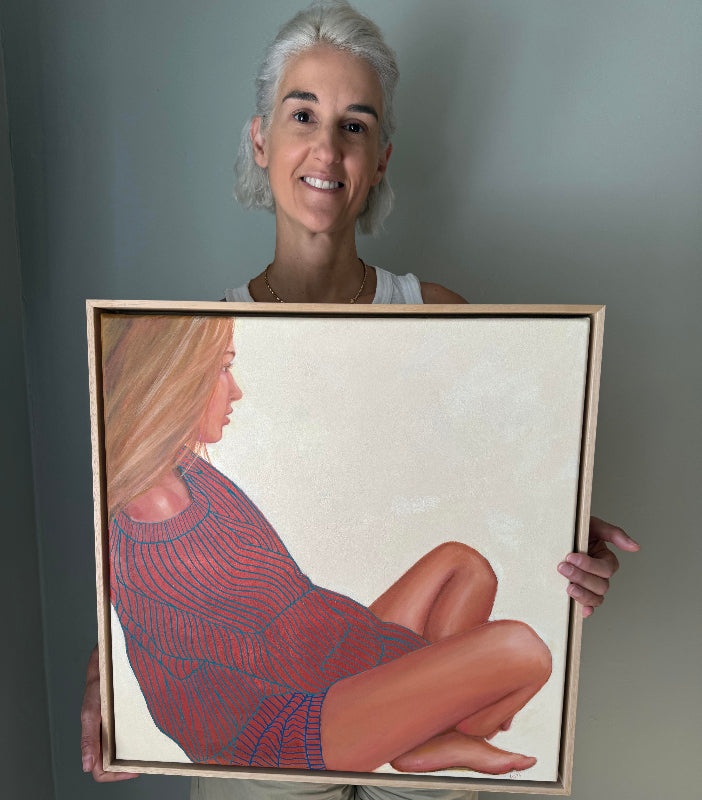
Product image: Handle with Care print
Despite all this, I still love the story of Cinderella, and I am not the only one, if continued adaptations are anything to go by. Key recent adaptations (apart from Bridgerton) include Camila Cabello's 2021 jukebox musical Cinderella, the upcoming Netflix animated film Steps (2026), centring on the stepsisters. Contemporary interpretations of Cinderella focus on modernising the fairy tale with feminist twists, not unlike what I tried to do in my painting.
I painted Cinderella as part of my Happily Ever After series. In my own depiction, Cinderella appears as a young girl looking at a mirror image of herself. No prince or fairy-godmother in sight: just a girl who saves herself.
In the centre of my painting (shown above) is a glass slipper which hovers just above her hand. I've always been fascinated with Cinderella's glass slipper. Can you think of anything more impractical? A beautiful but brittle covering for her precious feet that are her only means of escape.
Cinderella was literally walking on glass. It suggests ideas of fragility and delicacy, which are often associated with femininity.
These two girls stand on either side of the slipper, as if they are discussing it. In this instance, the glass slipper becomes a symbol for her own destiny, one that she holds in her hands (rather than on her feet!). It is precious and worthy of protection, like Cinderella herself.