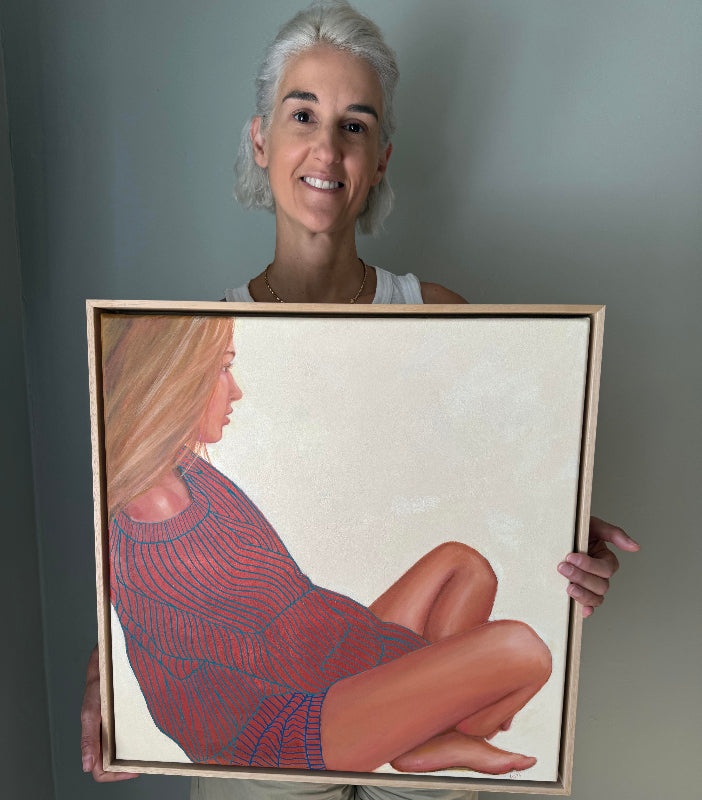

Mothers as Vessels: What Women Carry
Mother’s Day is a time to celebrate, but it’s also a moment to reflect. While mothers are praised as essential, these same women are often still treated as secondary citizens. Throughout history, mothers have been viewed as vessels: something that holds, supports, and sustains life. However, women are so much more than that and often their contributions are overlooked.
We are all aware of the unpaid labour that women perform: mothers who carry the majority of housework, the mental load, and the emotional labour. As American artist Maira Kalman puts it, “Women hold the home, family, children, food, friendships, work, memories, troubles, sorrows, triumphs, and love, sometimes feeling they can hold the world.” Until, of course, they feel they can carry no more.
“Women hold the home, family, children, food, friendships, work, memories, troubles, sorrows, triumphs, and love, sometimes…the world.”
Even in pregnancy, a woman is said to be “carrying” the baby, as though she is holding it on behalf of the father. In reality, she is creating life with her own blood, sweat and tears, often at a significant cost to her own physical and mental wellbeing. This language undermines the mother’s contribution to the creation of the child.
After she has “carried” and “delivered” the baby, the child is typically given the father’s surname. If the child is a boy, he may also inherit a paternal first and/or middle name, like in the case of Donald Trump junior. In many cases, there is no acknowledgement of the mother’s side of the family in the naming of the child, as though the maternal line has made no meaningful contribution. It reinforces the idea that the woman is merely a vessel assisting in the continuation of the male line.
There is a long history of women being described as vessels, containers, or vases. It appears across art, literature, mythology, and philosophy, and is tied to ideas of the body, fertility, beauty, and containment, as seen through the male lens. For instance, American artist Man Ray’s Le Violon d’Ingres (1924) depicts model Alice Prin with holes painted on her back, transforming her into a violin. The image has become an icon of Surrealist art and is just one of many examples of a woman’s body being compared to a decorative object, like a vase and an hourglass.

The woman as an object becomes a metaphor for a woman whose value is tied to preservation and containment. She is the keeper of man’s honour and his secrets. A classic example is the myth of Pandora’s box (originally a jar). As the first woman, Pandora is often interpreted as the container for all the evils of humankind, before she unwittingly releases them upon the world. In this way, women are framed as vessels for men’s thoughts, ideas and emotions, in addition to their sperm and their offspring.
The broader cultural narrative has often positioned man as the original human and woman as the pretty accessory. In the Book of Genesis, Eve is created from Adam: “This one is bone from my bone, and flesh from my flesh… she will be called ‘woman,’ because she was taken from ‘man.’” The irony, of course, is that in biological reality, men are made from women and not the other way around.
All humans begin as female. It is only around seven weeks of gestation that a gene on the Y chromosome triggers the development of male reproductive organs. This shared developmental origin is why men have nipples despite having no biological function for breastfeeding. In this sense, Adam is made from Eve.
The biological connection between mother and child is also profound. During pregnancy, foetal cells cross the placenta and can remain in the mother’s body for decades. In another remarkable aspect of human biology, a baby girl is born with all the eggs she will ever have. This means that when a woman is pregnant with a daughter, she is also “carrying” the genetic material of her potential grandchildren. It is a powerful illustration of how deeply interwoven maternal lineage truly is.

Despite this, lineage has historically been recorded through the male line. Nowadays, everyone can trace their maternal ancestry through mitochondrial DNA, but only men can test and trace their paternal line through Y-DNA. The Y-DNA is passed down only to male descendants, along with the family name and financial inheritance, it seems.
Before modern DNA testing, there was actually no reliable way to prove paternity. Maternity, on the other hand, is certain since pregnancy is witnessed publicly and conception is not. And yet, children are given the (probable) father’s name rather than the mother’s name, which seems illogical when viewed through this lens. However, it does make sense when we remember that these traditions emerged from a time when women and children were considered the property of men, a legacy that still lingers today.
In societies where women have autonomy and wives are not confined to the home, paternity is not guaranteed. In the book Sex at Dawn (2010), the authors describe the Mosuo tribe of southwest China, where men raise their sisters’ children. These are the only children they can be certain are biologically related to them. In the absence of certainty around paternity, directing that investment toward a sister’s children, whose genetic link is guaranteed, is a more reliable strategy for passing on one’s own genes and ensuring the continuation of the male line.
As humans, we are very concerned with the continuation of our own genes, which is why a woman’s value has been tied to her ability to bear children. In some cultures, particularly among the upper classes, wet nurses were employed so that wives could resume reproduction quickly, as breastfeeding naturally delays fertility. Once a woman can no longer bear children, her perceived value declines. In some cases, unfruitful wives would be shipped off to nunneries, or older wives are swapped out for younger ones who can still provide offspring.
Yet humans are one of the few species in which females live long beyond their reproductive years. We are one of the few mammals to experience menopause. Women also live longer than men. If a woman’s sole purpose were reproduction, this would make little evolutionary sense. A more compelling explanation is that older women contribute through knowledge, care, and social cohesion, supporting younger generations in meaningful ways.

Despite this, older women are often overlooked. Where older men are frequently elevated to positions of authority (insert judges, presidents, and popes' names here), older women are more likely to be ignored or dismissed. Historically, older outspoken women were persecuted and even burned at the stake. While the consequences are less extreme today, the marginalisation persists. In fact, women over 55 are among the fastest-growing groups experiencing homelessness in Australia, with the number nearly doubling between 2011 and 2023. Many (if not most) of these women are mothers and they are not valued and supported by our society.
It is also important to recognise that women who are not mothers also contribute enormously to society. Professor Scott Galloway has observed that single women are more likely to remain socially connected and engaged in their communities, while single men are increasingly at risk of isolation and disengagement. Women (whether mothers or not) are more likely to volunteer, care for younger or ageing relatives, and provide emotional support, often in unpaid and unrecognised ways. Women have a stabilising effect on society, and yet they are often blamed when things go wrong (see Pandora!). Their contributions are often overlooked.
So this Mother’s Day, it is worth acknowledging not only the unseen physical and genealogical contributions of mothers, but the broader contributions of women as a whole: the physical, emotional, and social care they provide to others ....every single day of the year.
Ramona magazine published this article on 8 May 2026.