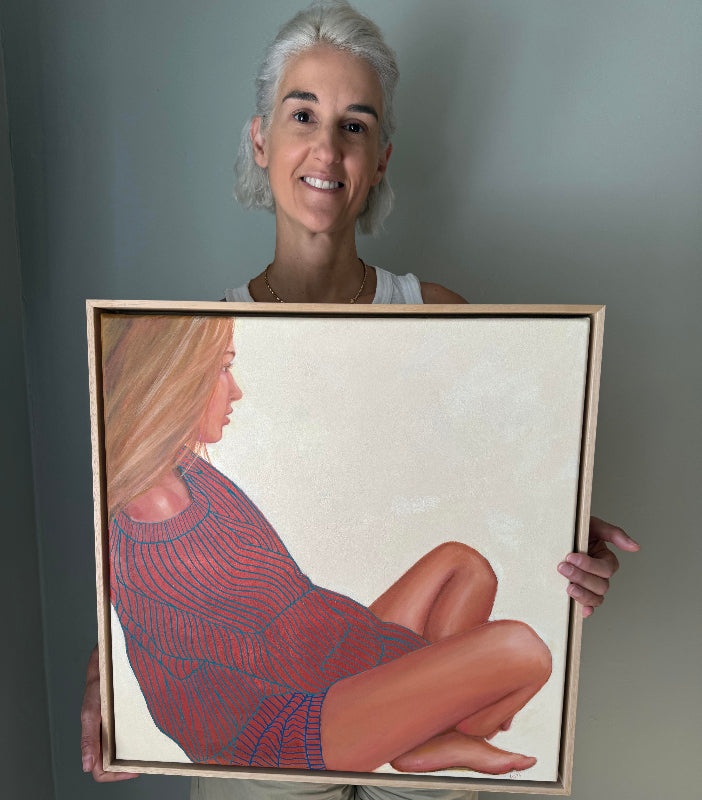

Art Collecting: Why your artworks are probably too small (and how to fix it)
Walk into almost any home and you’ll see a beautiful artwork, thoughtfully chosen, but hovering on a wall that’s far too big for it. The issue isn’t taste or budget: it's the psychology of playing it safe, as smaller artworks feel less risky. They’re easier to imagine on the wall and are more affordable.
But walls don’t work on the same scale as a gallery shelf or a coffee table. A standard wall is a huge visual field, and when the artwork doesn’t hold its own, it can feel oddly apologetic, even if the artwork itself is beautiful.
Walls need presence, not politeness. Interior designers have known this forever: scale matters more than almost anything else.
A small artwork on a large wall doesn’t just disappear; it visually shrinks the room. It creates an empty space that feels unresolved, like a sentence that never quite finishes.
Larger artworks, on the other hand, can anchor a room by creating a focal point. It can also make a space feel intentionally curated rather than decorated. This is why a larger artwork often makes rooms feel calmer, not busier. They simplify the visual noise instead of adding to it.
A Checklist: How to choose the right size artwork
If you’re unsure what size to buy, run through this simple checklist:
- ✅ Measure your wall first and then measure again
- ✅ Artwork should generally fill at least 60–75% of the available wall width
- ✅ Above the furniture, aim for artwork that’s two-thirds the width of what’s below it
- ✅ If the wall feels empty with the artwork centred, it’s probably too small
- ✅ When in doubt, size up
If you’re hesitating between two sizes, choose the larger one. Future you will thank you.
Quick size guide for common scenarios ⬅️➡️
| Wall Type | Ideal Artwork Size |
|---|---|
| Above sofa/bed (180–240 cm) | 120–160 cm wide |
| Feature wall (3–4 meters) | 150–220 cm wide |
| Narrow wall | 40–70 cm wide (vertical) |
| Gallery wall | Total grouping = 60–75% of wall |

Height placement ⬆️
- Centre of the artwork should sit at 145–155 cm from the floor (average eye level)
- Above furniture: Bottom of the artwork 20–30 cm above the furniture
This keeps the piece visually connected to the room, not floating.

Where my artworks work best
Medium-sized works that are incredibly versatile and easy to live with. They’re ideal for:
- Smaller or narrower walls, where a large statement piece would overwhelm
- Bedrooms, particularly above a bed, where you want presence without heaviness
- Hallways or stair landings, where a strong vertical or portrait-format work shines
If you have a window, doorway, or architectural feature, two matching or closely related works can be hung side-by-side to beautifully frame the space and create balance without needing a single oversized piece.
My smaller works are perfect for:
- Multi-hangs or salon-style walls, where they can be layered with other pieces
- Bookshelves or ledges, where art can be styled with objects and books
- Adding detail and personality to corners that don’t suit large-scale art
Small works thrive when they’re part of a story, not when they’re left to stand alone on a big, empty wall.
The takeaway
If your wall feels empty, unfinished, or a little underwhelming, the solution often isn’t more decor: it’s more scale, or better use of scale. Your home can handle it.
Your art deserves the space to be seen.
Next read >> Top Things to Consider When Buying Art for Your Home